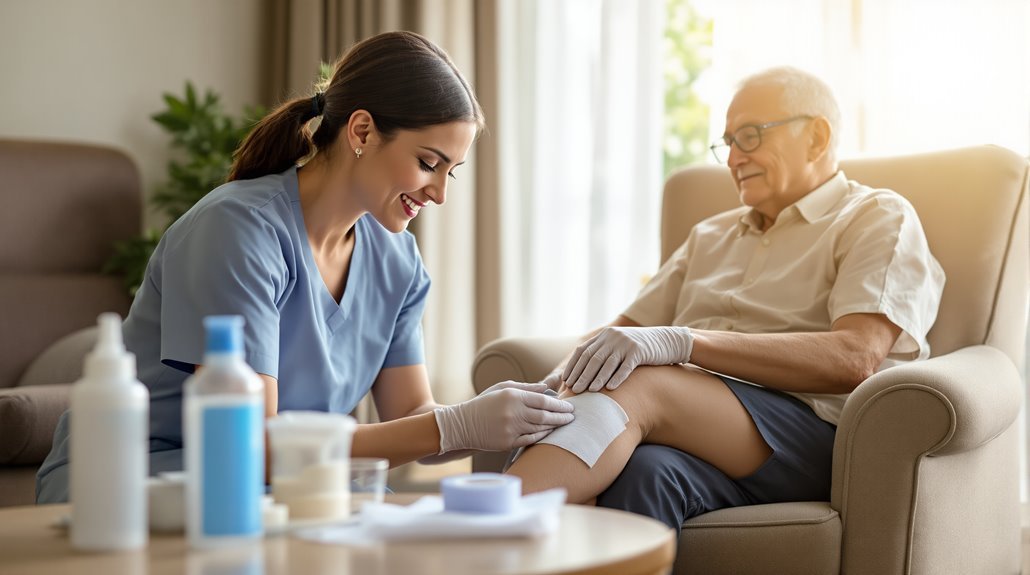
During your first in-home wound care visit, you’ll receive an extensive assessment documenting your wound’s dimensions, depth, and characteristics, along with a review of your health history and medications. Your care team will identify underlying factors like diabetes or circulation issues, then develop a personalized, evidence-based treatment plan addressing both your wound and its root causes. You’ll learn proper dressing techniques and infection monitoring while your team establishes systematic follow-up protocols to track healing progress and adjust treatments as needed.
Key Takeaways
- Comprehensive initial assessment documenting wound characteristics, health history, medications, and underlying conditions affecting healing with photographs for progress tracking.
- Development of personalized treatment plan addressing root causes like diabetes or circulation issues through evidence-based interventions and targeted therapies.
- Education on proper dressing changes, hygiene practices, infection monitoring, and behaviors that impede healing like smoking or excessive movement.
- Regular follow-up visits to measure wound dimensions, evaluate healing progress, and adjust treatment protocols based on documented changes.
- Ongoing communication between patient and care team for reporting concerns, providing feedback, and ensuring effective collaboration with physicians.
Your First Home Wound Care Visit
Your first home wound care visit establishes the foundation for effective healing through a systematic assessment and personalized treatment strategy.
The wound care specialist will conduct a thorough intake, documenting your health history, wound origin, and previous treatments. They’ll perform a detailed examination, measuring wound dimensions, depth, and characteristics while photographing the site for tracking progress. Your underlying conditions and medications will be reviewed to identify factors affecting healing.
Based on this assessment, your wound care specialist will develop a personalized treatment plan incorporating advanced dressings, debridement if needed, and nutritional guidance.
You’ll receive clear home wound care instructions for dressing changes and recognizing signs of infection. This evidence-based approach guarantees superior chronic wound care outcomes, with scheduled follow-up visits to monitor your healing progress.
Comprehensive Wound Assessment and Documentation
The initial assessment conducted during your first visit sets the stage for ongoing systematic evaluation that forms the backbone of effective wound management.
Your first visit’s comprehensive assessment establishes the foundation for continuous monitoring that drives successful wound healing outcomes.
Your wound care nurses will meticulously document wound size, depth, location, drainage characteristics, and infection indicators through precise measurements and photographs. This thorough assessment extends beyond the wound itself—they’ll review your health conditions like diabetes or venous insufficiency that may impact healing progress.
Circulation testing, including ankle-brachial index measurements or ultrasound studies, helps identify blood flow issues requiring intervention. Each documented detail directly informs your personalized treatment plan, enabling nurses to track improvements and adjust therapies accordingly.
This evidence-based approach guarantees you receive targeted care that addresses both the wound and underlying factors affecting recovery.
Understanding the Root Causes of Your Wound
While surface symptoms reveal what you can see, successful wound healing demands identification and treatment of the conditions driving tissue breakdown beneath your skin.
Your medical team will investigate underlying factors like diabetes, venous insufficiency, or arterial disease that impede recovery. Circulation testing, including ankle-brachial index measurements and ultrasound, evaluates blood flow to affected tissues.
Your providers will assess nutritional status, mobility limitations, and concurrent health conditions that impact healing outcomes. This thorough investigation enables your medical team to develop a targeted care plan addressing both the wound and its root causes.
Evidence-based interventions—specialized dressings, debridement protocols, and nutritional support—can then be implemented for wound care at home.
Understanding these underlying factors helps prevent infections and promotes ideal wound healing through precisely tailored treatment strategies.
Development of Your Personalized Treatment Plan
Once your wound’s root causes are identified, your healthcare team will construct a treatment protocol specifically calibrated to your clinical presentation and healing capacity.
Your personalized care begins with a thorough assessment documenting wound dimensions, tissue characteristics, and relevant health history. The home health team will implement evidence-based interventions including debridement for nonviable tissue removal, advanced moisture-retentive dressings, and targeted therapies addressing your specific healing barriers.
Evidence-based wound care combines precise assessment with advanced interventions tailored to your unique tissue characteristics and healing barriers.
Nutritional guidance becomes integral to your treatment plan, particularly for patients requiring diabetes management or dietary enhancement. Your care team schedules systematic follow-up visits to evaluate healing trajectories and modify protocols as needed.
Collaboration with your primary physician ensures the treatment plan addresses underlying conditions—poor circulation, infection susceptibility, or comorbidities—that impact recovery. This coordinated approach empowers patients and caregivers with clear expectations and favorable outcomes.
Wound Care Procedures and Advanced Therapies
When wounds fail to respond to conventional treatments, advanced therapeutic interventions become essential components of your home-based care regimen. Your nurse will perform thorough wound assessments, measuring size, depth, and tissue characteristics to guide treatment decisions.
Advanced therapies like Vacuum Assisted Closure (VAC) technology may be implemented, using controlled suction to stimulate tissue growth and accelerate healing. Debridement procedures remove dead or infected tissue, preventing complications and creating ideal conditions for recovery.
Specialized dressings maintain appropriate moisture levels while protecting against infection, with selection based on your wound’s specific needs. Beyond direct wound care, you’ll receive nutritional guidance to support healing from within, as proper nutrition directly impacts tissue repair and immune function, reinforcing your all-encompassing treatment approach.
Education on At-Home Wound Care Techniques
Successful wound healing depends greatly on your ability to execute proper care techniques between professional visits. Your home health care team members will provide thorough education on wound care protocols tailored to your specific needs.
You’ll learn precise dressing change techniques, including frequency and appropriate materials selection. The education covers essential hygiene practices and infection monitoring—recognizing warning signs like increased redness, swelling, or discharge.
Your team will emphasize behaviors that impede healing, such as smoking and excessive movement, which you must avoid. Nutrition plays a crucial role in tissue repair, so you’ll receive evidence-based dietary guidance focusing on adequate protein intake and hydration.
This structured education empowers you to become an active participant in your healing journey while serving as your own primary caregiver.
Monitoring Progress and Treatment Adjustments
Your healthcare professional will conduct systematic wound assessments during each visit, establishing measurable benchmarks that track your healing trajectory.
They’ll document wound size, depth, and appearance while evaluating critical indicators like redness, swelling, or drainage that signal potential infection. This evidence-based monitoring enables precise treatment adjustments tailored to your wound’s response.
When your care team identifies changes requiring intervention, they’ll collaborate directly with your physician to modify the treatment plan immediately.
These regular follow-up visits guarantee your wound care remains responsive to your evolving health needs. Through consistent documentation and clinical observation, your healthcare provider optimizes healing outcomes while empowering you with knowledge about your progress.
Regular follow-up visits ensure your wound care adapts to your changing needs while keeping you informed about your healing progress.
This patient-centered approach delivers thorough care that adapts as your wound heals.
Communication With Your Healthcare Team
Effective wound healing depends on open, consistent dialogue between you and your care providers. Your healthcare team develops a personalized plan tailored to your specific wound characteristics, but successful outcomes require your active participation. You’ll receive detailed instructions for how to care for your wound at home between visits, and you have the right to choose your preferred provider—enhancing trust and communication quality.
| Communication Element | Your Role | Team’s Role |
|---|---|---|
| Progress Updates | Report changes, concerns | Assess healing status |
| Care Instructions | Ask clarifying questions | Provide clear guidance |
| Treatment Adjustments | Share feedback honestly | Modify plan as needed |
| Physician Collaboration | Maintain contact with doctor | Coordinate thorough care |
| Questions/Concerns | Voice issues promptly | Address concerns immediately |
Conclusion
Your in-home wound care journey requires active participation and open communication with your care team. You’ll notice measurable progress through consistent assessment, evidence-based treatments, and proper technique adherence. Don’t hesitate to report changes in your wound’s appearance, increased pain, or new symptoms between visits. Remember, you’re not managing this alone—your wound care specialist partners with you and your physician to achieve ideal healing outcomes. Together, you’ll work toward complete wound closure and prevention of recurrence.