Mobile wound care reduces hospital readmissions by delivering specialized treatment directly to your home, cutting rates from 25% to just 12%. You’ll receive continuous monitoring with advanced diagnostic tools that detect complications early, preventing emergencies before they escalate. This approach eliminates travel burdens while reducing your exposure to hospital-acquired infections. Personalized care plans and consistent bedside assessments guarantee you’re adhering to treatment protocols, resulting in faster healing and approximately $2,000 in cost savings per patient. The extensive framework supporting these outcomes reveals why healthcare systems are increasingly adopting this patient-centered model.
Key Takeaways
- Mobile wound care reduces hospital readmissions from 25% to 12%, saving approximately $2,000 per patient through consistent monitoring and treatment.
- Specialized teams with advanced diagnostic tools enable immediate clinical decisions and instant treatment adjustments, preventing complications requiring hospitalization.
- Home-based care eliminates travel burdens and increases treatment compliance, leading to optimized healing outcomes and fewer readmission events.
- Reducing exposure to hospital-acquired infections and transit-related contamination supports faster wound closure and decreases readmission risks.
- Regular bedside assessments track wound size and infection signs, enabling proactive management that prevents emergencies and hospital returns.
The Growing Challenge of Hospital Readmissions in Wound Care
Hospital readmissions for wound care patients represent a critical pressure point in the healthcare system, with rates reaching as high as 25% and imposing substantial financial burdens on both institutions and patients.
You’re witnessing a paradigm shift as mobile wound care services demonstrate measurable impact on these statistics. Research shows these interventions achieve just 12% readmission rates through personalized care delivered directly in patients’ homes.
Mobile wound care services cut hospital readmissions to just 12% through personalized treatment delivered directly in patients’ homes.
When you implement tailored treatment protocols for chronic wounds, you’re preventing complications before they escalate. Your patients experience faster healing times and improved patient outcomes because they’re receiving consistent, specialized attention.
This evidence-based approach addresses the root causes of readmissions while generating approximately $2,000 in cost savings per patient—resources you can redirect toward serving more individuals requiring wound care.
How Mobile Wound Care Delivers Timely Intervention at the Bedside
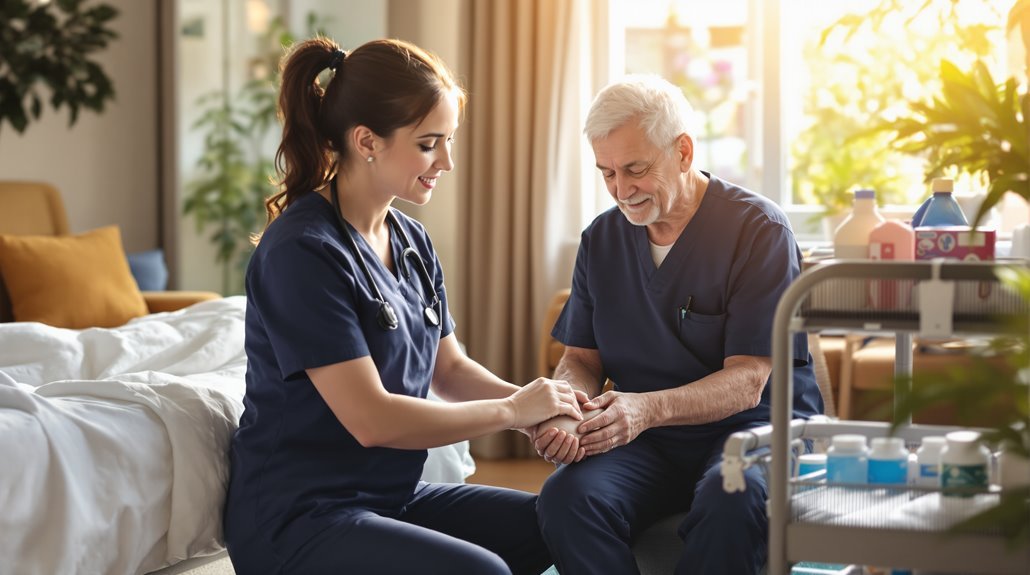
When specialized wound care teams arrive at your patient’s bedside, they’re equipped with advanced diagnostic tools and treatment materials that enable immediate clinical decision-making without the delays inherent in traditional care delivery models.
This mobile wound care approach delivers timely interventions that directly impact patient outcomes—studies demonstrate home-based wound care reduces readmission rates to 12%, compared to 25% with traditional models.
Your specialized care teams can instantly adjust treatment protocols upon detecting infection or inflammation, preventing escalation that typically necessitates hospitalization.
By eliminating transportation barriers and providing wound care in familiar surroundings, you’ll enhance treatment adherence while maintaining clinical rigor.
These frequent bedside assessments create multiple intervention points, allowing you to reduce hospital readmissions through proactive management rather than reactive crisis response.
Continuous Monitoring and Early Detection of Complications
Regular bedside assessments create the foundation for systematic wound surveillance that identifies complications before they require emergency intervention.
When wound care specialists conduct frequent home visits, they track critical indicators—wound size, color, drainage patterns, and infection signs—enabling early detection of deteriorating conditions.
This continuous monitoring approach proves remarkably effective: home-based wound care demonstrates a 12% readmission rate compared to 25% for hospital treatment.
You’ll find that personalized wound care at home encourages stronger treatment adherence, as patients feel more comfortable and engaged in their healing process.
For chronic wounds particularly, this proactive management model prevents minor issues from escalating into emergencies.
The combination of specialized expertise and convenient access fundamentally transforms outcomes, reducing hospital readmissions while delivering superior care where patients need it most.
Enhanced Treatment Adherence Through Convenient At-Home Care
Because traditional wound care models require frequent clinic visits that disrupt daily routines and create transportation barriers, patients often struggle to maintain consistent treatment schedules—a problem that mobile wound care directly addresses through its home-based delivery model. Wound care at home delivers enhanced treatment adherence by eliminating transportation stress, allowing you to focus resources on recovery rather than logistics.
| Adherence Factor | Clinic-Based Care | Mobile Wound Care Services |
|---|---|---|
| Travel Burden | High | Eliminated |
| Schedule Flexibility | Limited | Maximized |
| Patient Understanding | Variable | Enhanced through personalized instruction |
| Compliance Rates | Lower | Noticeably higher |
| Healing Outcomes | Compromised by missed visits | Optimized through consistency |
Research demonstrates that improved adherence through mobile wound care services directly impacts chronic wounds management, reducing complications that lead to hospital readmissions while accelerating healing trajectories.
Specialized Expertise Without the Need for Hospital Visits
While hospital-based wound care centers maintain reputations for clinical excellence, mobile wound care services now deliver that same specialized expertise directly to your bedside—eliminating the physical and logistical burden of facility visits without compromising treatment quality.
Healthcare providers trained in advanced wound care techniques bring thorough wound assessment capabilities and treatment protocols to patients’ homes, maintaining clinical standards identical to facility-based care.
This specialized wound care approach enables your team to implement evidence-based interventions while reducing the need for transportation and exposure to hospital-acquired infections.
Studies demonstrate that this model achieves patient outcomes comparable to clinic settings, with home-based wound care showing a 12% readmission rate versus 25% for in-hospital treatment—proving that specialized expertise thrives outside traditional healthcare facilities when delivered systematically.
Preventing Hospital-Acquired Infections With Home-Based Treatment
Hospital-acquired infections (HAIs) present a documented threat to wound healing, with studies showing that 5-10% of hospitalized patients develop at least one infection during their stay. Home-based treatment fundamentally transforms infection prevention by eliminating exposure to hospital pathogens. Your patients receive wound care in controlled, sanitized environments, greatly reducing complications that compromise healing.
| Hospital Setting | Home-Based Treatment |
|---|---|
| High pathogen exposure | Minimal environmental contamination |
| Wound dehiscence risk elevated | Cleaner environments support closure |
| Travel infection transmission | Zero transit-related exposure |
| Frequent HAI complications | Controlled infection prevention |
| Higher readmission rates | Enhanced recovery outcomes |
Mobile wound care’s infection-prevention advantages directly support your mission of serving patients effectively. By reducing hospital-acquired infections through home delivery, you’re protecting vulnerable individuals while promoting ideal healing conditions.
Personalized Care Plans That Promote Faster Healing
Personalized care plans represent the clinical foundation of mobile wound care‘s superior healing outcomes.
When you deploy specialized wound care professionals to patients’ homes, they conduct thorough assessments that inform treatment protocols tailored to each wound‘s specific characteristics. This individualized approach enables faster healing through precise interventions that address underlying physiological factors impeding recovery.
Your multidisciplinary team’s regular evaluations facilitate timely modifications to wound management strategies, optimizing patient outcomes.
Evidence demonstrates this effectiveness: personalized care plans delivered through home care achieve a 12% readmission rate compared to traditional hospital-based treatment’s 25% rate.
By customizing interventions to each patient’s unique clinical presentation, you’ll reduce hospital readmissions while accelerating tissue repair.
Patients consistently report higher satisfaction and demonstrably improved healing trajectories under personalized mobile wound care protocols.
Cost Savings and Improved Outcomes for Healthcare Systems
Mobile wound care’s clinical advantages translate directly into substantial financial benefits for healthcare systems facing mounting pressure to deliver quality outcomes while controlling expenditures.
You’ll find that implementing these services generates approximately $2,000 in cost savings per patient through reduced hospital visits and complications.
The evidence is compelling: mobile wound care achieves 12% hospital readmission rates compared to 25% for traditional in-hospital care, while simultaneously accelerating wound healing times.
California’s elderly patient program demonstrates this dual impact perfectly, showing a 30% reduction in readmissions alongside a 40% increase in patient satisfaction.
Conclusion
You’ll find that mobile wound care directly addresses readmission risks through evidence-based interventions delivered in your home. By receiving specialized treatment at your bedside, you’re less exposed to nosocomial infections while maintaining consistent care protocols. Your clinician can detect complications early, adjust your treatment plan promptly, and guarantee you’re adhering to prescribed regimens. This approach doesn’t just improve your healing outcomes—it measurably reduces your readmission risk while lowering healthcare system costs through prevention rather than reactive hospitalization.